
What a French Riviera Second Home Really Costs Each Year
The real annual cost of a second home on the French Riviera is rarely just tax and utilities. For many owners, the decision to let the property turns on co-ownership charges, insurance, pool and garden upkeep, and the maintenance budget they forgot to set aside.
In 2026, the taxe d’habitation still applies to second homes in France, and in many tight-market communes it can be increased. Tax notices are available from 2 November for taxpayers who do not pay monthly and from 16 November for those who do, with a payment deadline of 15 December 2026. That matters because for many Riviera owners, the annual running cost of a second home is the number that decides whether letting it out is worth the effort at all.
And the tax bill is only one line.
On the French Riviera, owners also carry co-ownership charges, insurance, utilities on a mostly closed property, pool and garden care, and the maintenance budget that tends to be ignored until a leak, failed shutter motor or damp mark appears after a storm. If you own in Nice, Beaulieu-sur-Mer, Èze, Cap-d’Ail or Roquebrune-Cap-Martin, this is the real conversation.
What are the real annual running costs of a French Riviera second home?
Start with the fixed charges you will pay even if you barely use the property: local taxes where they apply, building charges if the property is in a co-owned residence, insurance, standing utility costs, and routine upkeep.
Then add the variable lines: pool servicing, garden maintenance, air-conditioning checks, cleaning after periods of closure, linen and restocking if you let the property, and repairs that were not planned when you bought.
That last category is where budgets drift. General maintenance and repair costs for a second home are often estimated at between 1% and 5% of the property’s purchase value each year. For a property occupied only around 35 days a year, some estimates place the long-smoothed cost higher, at 5% to 7% of value over 10 years. You do not need to panic at the upper end every year, but you do need a maintenance line in the budget.
If you are trying to decide whether to rent the property seasonally, this is the figure to work from: gross rental income minus taxes, charges, operating costs and wear. Not the headline weekly rate.
Taxe d’habitation on second homes in 2026: what owners need to check
For French second homes, the taxe d’habitation has not disappeared. In 2026 it remains due on secondary residences, and some communes apply a surcharge in tense housing areas. Across France, 1,666 communes apply a surcharge on the tax for second homes in 2026, and 688 of them have chosen the maximum increase of 60%. The surcharge is calculated from the property’s cadastral rental value.
If you want the official position, check Service-Public.fr and Impots.gouv.fr. The practical point is simple: before you estimate profitability, confirm the local tax position of the exact commune and the exact property.
Owners often focus on the tax and forget the timing. If the property is owned through a family arrangement, used irregularly, or let part of the year, it is worth checking early who receives notices and who actually pays them.
Charges résidence secondaire France: the annual lines owners forget
Searches for charges résidence secondaire France usually start with tax. In practice, the quieter costs are often what make the difference.
Insurance
Average home insurance for a second home in 2026 is estimated at around €352.87 per year, with other sources placing typical ranges between €226 and €500 depending on the cover selected. It may not be legally compulsory in every case, but for a home that sits empty for stretches, it is difficult to treat as optional.
Utilities in a closed property
Even when a home is shut up, there are usually standing electricity and water costs. Add occasional heating or dehumidification in winter, internet if you want remote monitoring, and reactivation or troubleshooting after long gaps.
Pool, garden and climate control
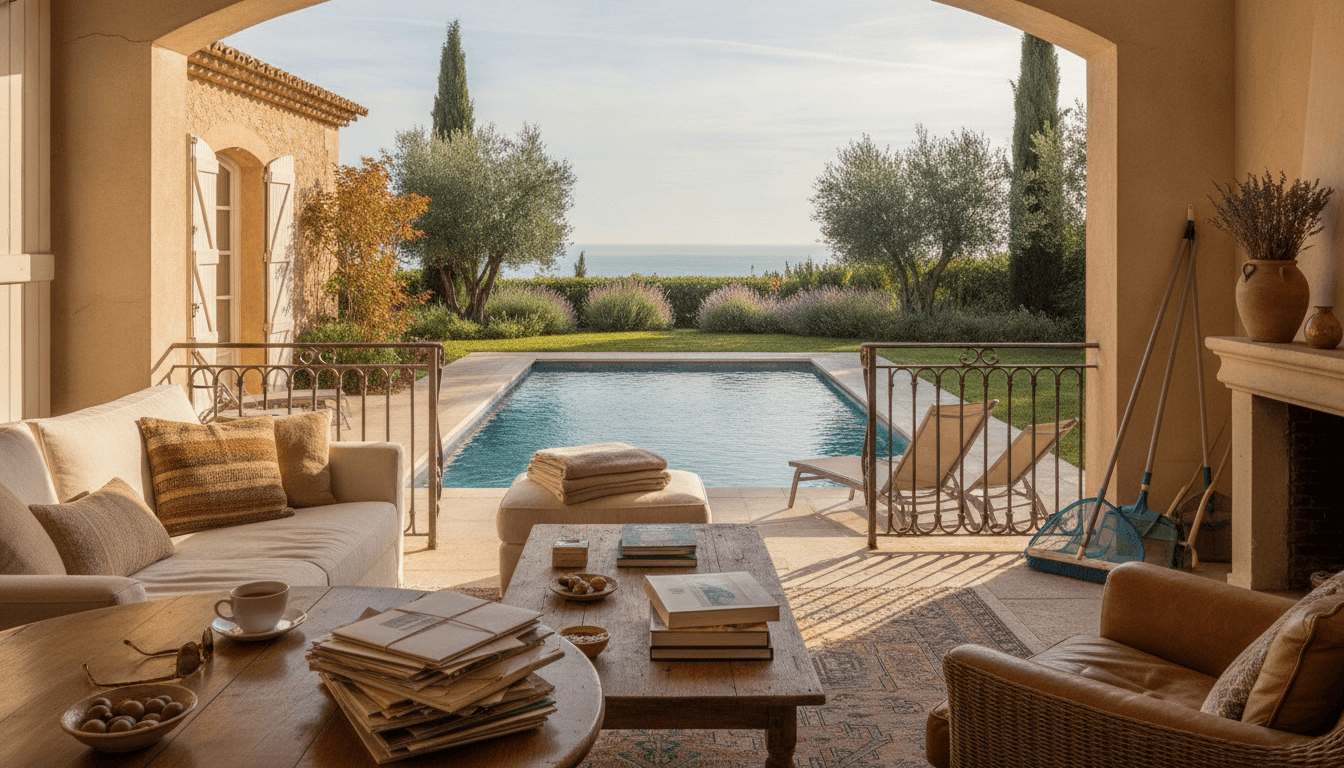
For a second home in the Var, annual upkeep for pool, garden and air-conditioning can range from €2,000 to €8,000 depending on size and equipment. On the Riviera, the principle is the same: external spaces and technical equipment continue to cost money whether guests arrive or not.
The repair line nobody budgets properly
Salt air, sun, storms and periods of closure are hard on coastal property. Shutters stick. Exterior joinery moves. Damp can appear without dramatic leaks. A smart budget includes both regular maintenance and a reserve for the things you only notice when you reopen the property.
Budget entretien villa Côte d’Azur: what remote owners should plan for
This is where ownership moves from accounting into organisation.
If you live in Paris, London, Geneva or New York, the issue is not only what maintenance costs. It is who notices the problem early, who gets access for quotes, who compares contractors, and who checks the result before the next family stay or tenancy.
That is the owner’s side of the equation, which sits under Property Care. Maison Cinq Étoiles handles this kind of on-the-ground follow-up for absent owners across Monaco, Menton, Roquebrune-Cap-Martin, Beausoleil, Cap-d’Ail, Èze, Beaulieu-sur-Mer, Villefranche-sur-Mer and Nice: inspection visits, photo reports, watching for damp and salt-air wear, meter checks, mail, and supervising works when repairs are needed. It is property management in the ordinary sense of the phrase, but our service is called Property Care because the focus is the asset, its condition and its running costs.
You do not need a full-service arrangement to do this. A local friend can open the shutters and glance around. Where a professional earns their fee is in regularity, documentation, and the dull but important follow-through with trades.
If you plan to let the property, does the maths still work?
Sometimes yes. Sometimes clearly not.
Seasonal letting can offset fixed costs, but only after you account for operating expenses honestly. On the Riviera, seasonal rental management fees commonly range between 20% and 25% of monthly rental income including VAT, often covering listing management, guest reception, supplier coordination and revenue follow-up.
That day-to-day rental operation belongs to Conciergerie, not Property Care. The distinction matters. Property Care protects the owner’s interest in the asset; conciergerie runs the address from one stay to the next, with key handover, arrival prep, linen, amenities, post-departure checks and vendor coordination.
Maison Cinq Étoiles does both, but they solve different problems. If your question is “who will meet the guest arriving late, prepare the apartment and inspect it after departure?”, that is conciergerie. If your question is “who will compare repair quotes, track costs and watch the long-term condition of the property?”, that is Property Care.
And before you count projected rental income, check the local rules.
In Nice, from 1 September 2026, the maximum rental period for a primary residence as a furnished tourist let is back to 90 days per year. Exceeding that limit can lead to a civil fine of up to €15,000 and requires authorisation for change of use. Monaco is different: there is no specific private-sector legislation aimed at short-term rental platforms, but co-ownership rules and lease restrictions can sharply limit what is practical, and subletting social housing is prohibited.
A practical checklist before you decide to keep, let or limit use
- Confirm whether taxe d’habitation applies and whether your commune applies a surcharge.
- List annual building or co-ownership charges.
- Check your insurance cover for vacancy periods.
- Add standing utility costs, not only active consumption.
- Budget for pool, garden and air-conditioning upkeep.
- Create a repair reserve for unplanned maintenance.
- If you plan to let, deduct management, guest-running and cleaning costs from projected income.
- Check the exact local rules for short-term rentals before furnishing the business plan around them.
- Decide who will inspect the property between stays or during empty periods.
FAQ
Is taxe d’habitation still payable on second homes in 2026?
Yes. In France, second homes remain liable for taxe d’habitation in 2026, and some communes apply a surcharge in tense housing areas.
How much should I budget for pool and garden maintenance on the French Riviera?
The research brief gives a reference range of €2,000 to €8,000 per year for a second home in the Var covering pool, garden and air-conditioning, depending on size and equipment. Your own property may sit outside that range, but it is a useful starting point.
Is using a property management company worth it for a Riviera second home?
If the property is used rarely and you live far away, often yes, provided you are clear about the scope. Asset oversight, inspections and repair supervision are one problem. Guest arrivals, key handovers and day-to-day hosting are another.
Can I rely on seasonal rentals to cover the running costs?
Only after you subtract taxes, charges, insurance, upkeep, management fees and wear. Many owners test the idea on gross income and get an answer that is too optimistic.
A Riviera second home can work beautifully, but only if you cost it as an operating asset rather than a postcard. Maison Cinq Étoiles helps owners do that in practical terms, with Property Care for the asset itself and conciergerie when the address needs to run smoothly between stays.
Get in Touch
Interested in our services? Send us a message and we'll get back to you shortly.