
Yacht Interior Design in Monaco: Real Constraints, Materials, Timing
On board, interior work follows a different logic than it does ashore. In Monaco and along the Côte d’Azur, the real questions are weight, fire behaviour, humidity, fixing methods, and how much can fit into the refit window between charters.
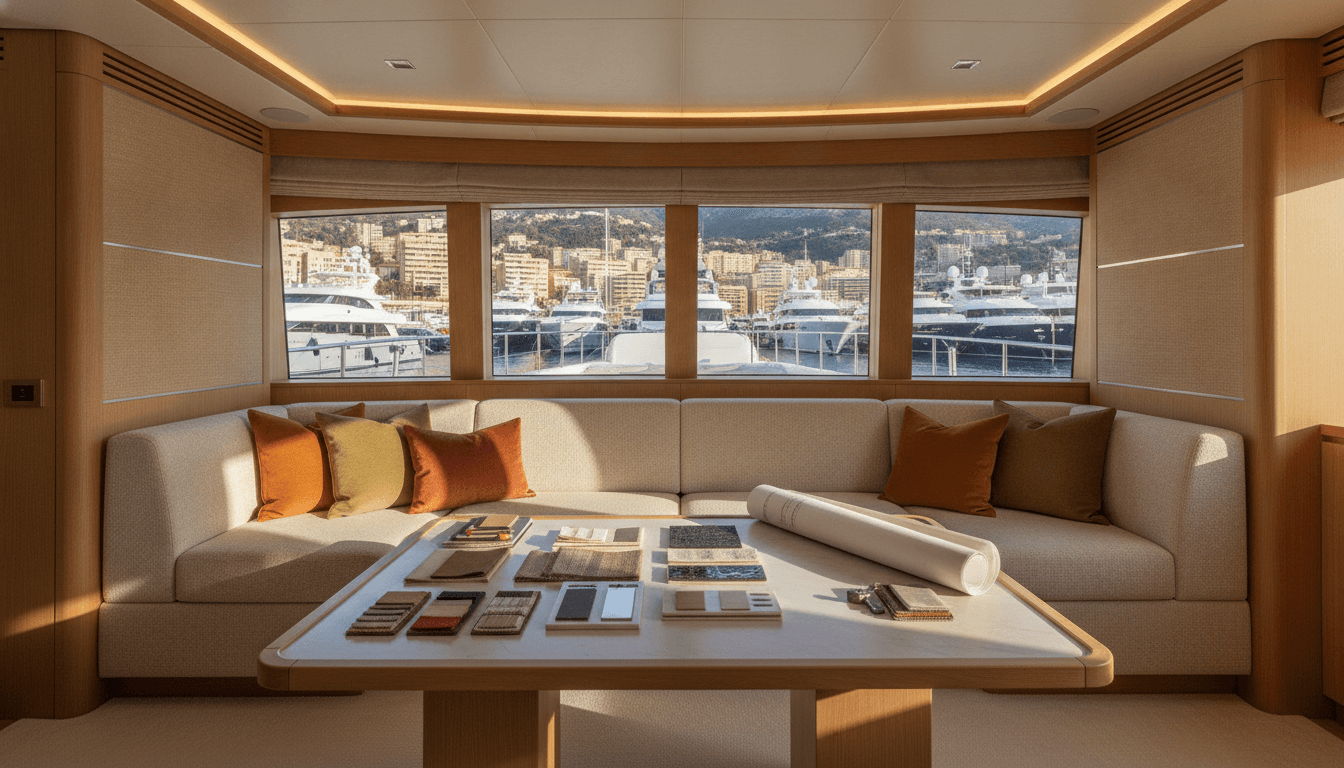
On a yacht, a fabric choice can become a fire-compliance question, a stone top can become a weight problem, and a simple bedside lamp can become a fixing issue once the boat starts moving.
That is the first thing owners usually underestimate about yacht interior design in Monaco. Interior work afloat follows a different set of constraints from a villa in Cap-d’Ail or an apartment in Monaco: salt air, high humidity, vibration, UV, marine fire standards, and a refit window that often runs between the end of one season and the start of the next. In the Mediterranean, that usually means work is planned from October through April or May.
If you are preparing a yacht for the next charter season, the useful question is not “can this be redesigned?” but “what category of work is this?” A soft furnishing refresh, a cosmetic interior update, and a structural refit are not the same project, and they do not involve the same people.
What makes yacht interior design different from interior work ashore?
Five constraints shape almost every serious brief.
- Weight. On board, added mass affects performance, stability and fuel use. That is why designers look at lightweight substrates, composite woods, and thin-cut stone panels backed with aluminium honeycomb rather than treating the yacht like a penthouse.
- Fixing. Furniture, lighting and decorative elements must stay put while the vessel moves. A loose side table may be charming in a home and a problem at sea.
- Fire behaviour. Marine interiors work to maritime standards, not domestic ones. The benchmark to name is IMO Resolution MSC.307(88), the 2010 FTP Code. For interiors, that covers applications such as curtains, upholstered furniture and bedding. Land standards that are common ashore are not automatic substitutes.
- Humidity, salt air and UV. Untreated timber, particleboard and finishes that behave perfectly well in a city apartment can fail quickly on board.
- Time. A yacht rarely sits still for months with no operational pressure. Charter bookings, owner use and marina logistics mean the programme has to be realistic from the start.
This is where yacht work often becomes less glamorous and more technical than people expect. A beautiful scheme still has to survive doors slamming in a swell, damp towels in cabins, sunscreen on banquettes, and repeated cleaning.
Which materials actually work for a yacht interior?
The short answer is: materials chosen for marine use, not merely for looks.
For timber, marine-grade species and properly specified finishes matter. Teak remains a familiar reference point because it tolerates the environment well. Metals need the same discipline. Stainless steel, brass and anodized aluminium are used because they stand up better to corrosion than decorative metals intended for dry interiors.
Textiles are where many yacht interiors date or fail first. For upholstery, bedding accents and window treatments, you need to think about fire behaviour, UV stability, moisture and cleaning frequency at the same time. High-performance, solution-dyed acrylic textiles are often preferred where sun and humidity are constant factors. For textiles marins yacht, softness on day one is not enough; the fabric has to keep its colour and structure after repeated use and maintenance.
For hard finishes, the same principle applies. If you want the look of stone, lightweight stone-faced panels may make more sense than solid slabs. If you want a flooring update during a refit intérieur yacht Côte d’Azur project, marine vinyl or marine-suitable carpet may be easier to phase than heavy or delicate alternatives.
Maison Cinq Étoiles handles this part through its interior design service: palettes, sourcing, soft furnishings, furniture selection and final installation for ready-to-use interiors. The point is not to produce a mood board that looks good at handover. It is to specify materials that can be lived with and maintained on board.
Aménagement intérieur yacht Monaco: what can change without a shipyard?
A lot can change visually without moving into a full yard-led rebuild.
In practice, a soft refit or cosmetic refresh may include reupholstery, bedding, curtains, removable soft furnishings, some flooring changes, wall coverings such as marine-suitable films or vinyl wallpaper, LED lighting upgrades, and selected hardware swaps. This is usually the territory of décoration yacht Monaco rather than structural renovation.
It is often enough to change how the yacht photographs, how fresh it feels for owner use, and how well the interior holds together across a season. If the layout already works, this category of intervention is usually the most sensible place to start.
What it does not cover is moving bulkheads, changing the vessel’s structure, overhauling engineering systems, hull work, or anything that affects class in a way that belongs to naval architects, engineers or shipyards. That line matters. Maison Cinq Étoiles does not undertake structural modifications, major systems work, or anything requiring shipyard or naval-architect responsibility. When a brief crosses into that territory, the honest answer is that it sits outside the house’s scope.
Soft refit vs full refit: where owners often misjudge the line
The confusion usually starts with one phrase: “We’re only updating the interior.”
If that means new headboards, replacement curtains, a fresher carpet, revised loose furniture, new linens, updated lighting and cleaner material choices, you are likely discussing a soft refit.
If it means reconfiguring cabins, changing fixed joinery in a way that affects structure, opening spaces, moving service zones, or coordinating major engineering implications, you are into full refit territory. That is shipyard work.
The practical distinction is less about style than about responsibility:
- Soft refit: design, sourcing, decorative upgrades, installation planning, onboard coordination where permitted.
- Full refit: shipyard scheduling, naval architecture, engineering, class and compliance pathways, structural execution.
Owners sometimes spend too long trying to force a structural ambition into a decorative budget and timeline. It is usually better to define the line early and build the brief around what can actually be delivered between seasons.
When should you plan a yacht interior refit on the Côte d’Azur?
For the Mediterranean, the working season for refit projects generally runs from October through April or May.
That does not mean every project should wait until winter to be discussed. The best time to define scope is often earlier, while you still have the previous season fresh in mind: which fabrics marked too quickly, which guest cabin lacked proper sleeping practicality, which lighting looked flat in photographs, which finishes were too fragile for regular charter use.
Then you can decide whether the project is:
- a straightforward soft refresh,
- a more involved interior refit with multiple trades, or
- a structural brief for a yard team.
Monaco remains a natural point of coordination for this work, not least because owners, captains and suppliers cross paths there throughout the season. For industry timing, the Monaco Yacht Show is one obvious marker; the 2027 edition is scheduled for September 22 to 25 at Port Hercule.
Maison Cinq Étoiles often earns its fee here not by adding drama but by reducing friction: defining what belongs to design, what belongs to operations, and what has to go to a yard before anyone orders fabric or furniture.
A practical checklist before you start an interior yacht project
- List what is cosmetic, what is fixed, and what may touch structure or systems.
- Confirm which materials need marine-grade specification.
- Check fire-compliance requirements for fabrics, curtains, upholstery and bedding.
- Identify anything heavy that may need a lightweight alternative.
- Review lead times for textiles, lighting and custom pieces.
- Decide whether the yacht will remain operational during the works.
- Plan access: marina rules, contractor timing, onboard storage and waste removal.
- Set the handover around real use, not an optimistic date.
How property care and conciergerie fit around a yacht interior project
An interior brief on board often touches two other pillars, and it helps to keep them separate.
If the issue is the owner’s asset decision, long-term maintenance cost, supplier comparison, or supervision of works in the owner’s absence, that is Property Care. It is the owner’s interest in the yacht as an asset and in the quality of decisions being made around it.
If the issue is day-to-day coordination around arrivals, linen, provisions, key access, meeting vendors, preparing the yacht before guest use, or checking the interior after departure, that is conciergerie. On a yacht as in a villa, the distinction matters because one is strategic oversight and the other is operational running.
Maison Cinq Étoiles works across both when the brief calls for it, but they are not the same service and should not be bought as if they were.
FAQ
What are the main technical constraints for yacht interior design?
Weight, fixing methods, fire behaviour, humidity, salt air, UV exposure and the short refit calendar between periods of use. Those constraints affect almost every material and installation choice.
Which materials are best for a yacht interior, especially for fire resistance and humidity?
Marine-grade woods, corrosion-resistant metals such as stainless steel, brass and anodized aluminium, lightweight composite solutions, and high-performance textiles suited to UV and moisture. Fire compliance needs to be checked against the relevant maritime standards for the intended use.
Can a yacht’s interior be redecorated without going to a shipyard?
Often, yes, if the work stays within a soft refit: upholstery, bedding, curtains, some flooring, wall finishes, lighting upgrades and decorative improvements. Structural changes and major systems work are another category and belong to shipyards.
What fire safety standards apply to fabrics and furnishings on a yacht?
The key reference is IMO Resolution MSC.307(88), the 2010 FTP Code, which sets fire test procedures for marine applications including curtains, upholstered furniture and bedding. For French regulatory context, Légifrance is the official source, and the IMO remains the international authority.
A yacht interior project goes well when the brief is honest about its category from the start. Maison Cinq Étoiles handles yacht interiors at the level of design, sourcing, soft furnishings and coordination on board, with a clear line where shipyard and naval-architect work begins.

Get in Touch
Interested in our services? Send us a message and we'll get back to you shortly.