
Furnishing a French Riviera Rental: What Actually Survives
On the Riviera, a rental interior can look right in photos and still fail by the second season. Here’s what holds up to salt air, sun, humidity, and repeated turnovers, and where remote owners usually spend twice.
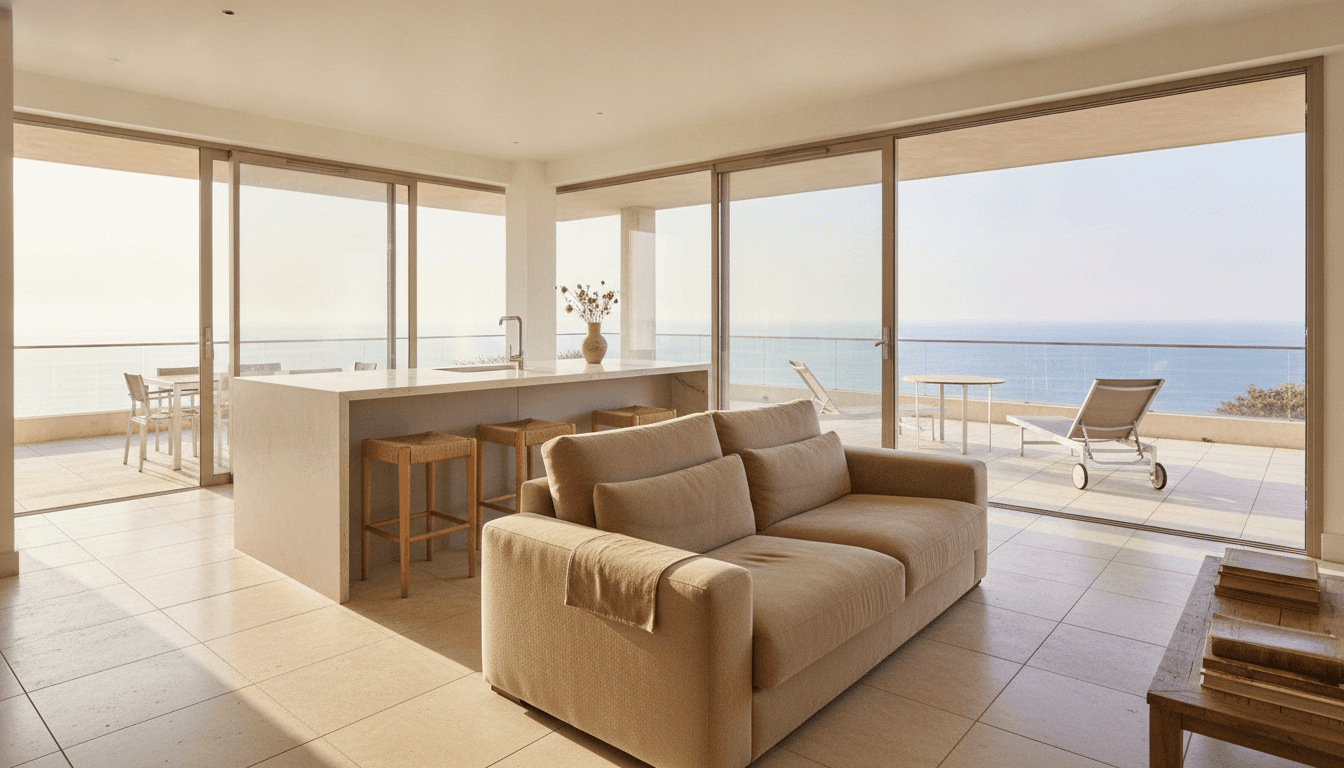
Buy the wrong sofa, terrace set, or bedside tables for a Riviera rental and the problem rarely shows up on delivery day. It shows up after a summer of direct sun, salty air drifting in from the coast, damp periods in a closed apartment, and repeated guest changeovers. Good interior design French Riviera rental work starts there, not with a mood board.
For remote owners in London, Geneva, Paris, Milan, or New York, this is where expensive year-two corrections begin. A flat in Nice, a villa in Èze, or a seasonal apartment in Beaulieu-sur-Mer may photograph beautifully at handover, then develop faded textiles, swollen wood, corroded fittings, and outdoor pieces that already look tired. If you are furnishing before you have ever maintained the property yourself, you need to specify for climate and turnover at the same time.
Interior design French Riviera rental: what fails first in real life
The Riviera is hard on interiors in very specific ways. Strong UV light fades fabrics faster than many owners expect. Salt-laden air accelerates corrosion on exposed metals, especially on terraces close to the sea in Monaco, Cap-d'Ail, Beaulieu-sur-Mer, or Villefranche-sur-Mer. Humidity in closed-up months can make wood swell, warp, or crack, especially where indoor conditions swing sharply.
What tends to fail first?
- Painted outdoor metal that chips, then corrodes.
- Raw or lightly protected wood on balconies and terraces.
- Delicate upholstery weaves that hold marks and fade in window-heavy rooms.
- Soft natural-stone kitchen tops chosen for looks, then stressed by guest use.
- Brass or copper fittings in hard-working rental kitchens and bathrooms where stainless steel is usually tougher.
This is why Airbnb interior design French Riviera should be judged less like a private pied-à-terre and more like a working asset. A rental can still feel warm and refined. It just needs the calm, durable version of refinement.
What materials actually survive a holiday let season on the Côte d’Azur
For interiors, the reliable choices are rarely the most theatrical ones.
For upholstery, microfiber and leather generally cope better with repeated use and easier cleaning than fragile decorative fabrics. For floors, ceramic tile and good-quality luxury vinyl plank are practical in high-traffic rentals; they handle sand, wheeled luggage, and regular cleaning better than many softer alternatives. For worktops, quartz, ceramic, and composite materials are usually safer choices than surfaces that ask every guest to behave like an owner.
In kitchens, utility rooms, and bathrooms, stainless steel fittings are often the sensible call. They may feel less romantic than brass or copper in a showroom, but they are more robust in a rental that is cleaned, wiped, and used constantly.
Outside, seaside conditions call for a stricter edit. The materials worth prioritising are resin, oiled teak, anodized aluminum, and textilène. They stand up better to marine conditions than painted metal or raw wood. Protective covers help, but so does not buying vulnerable pieces in the first place. Fresh-water rinsing matters as well, especially on exposed terraces.
Owners often ask for a polished Riviera look. The practical version is this: teak rather than untreated softwood, anodized aluminum rather than painted steel, textilène rather than cushions that live outdoors full-time, and ceramics where a photo might otherwise tempt you into something porous.
Interior design French Riviera rental also means humidity planning
Closed shutters and an empty apartment do not preserve furniture by magic. On this coast, humidity is part of the specification brief.
Wood furniture is particularly sensitive to moisture swings. An indoor relative humidity band of 35% to 55% is considered ideal, and rapid fluctuation is especially damaging. In practice, that means a beautiful timber bedside table can behave very differently in a regularly aired apartment in Nice than in a second home shut up for stretches in Roquebrune-Cap-Martin.
So when furnishing a holiday let in France, ask boring but useful questions:
- Will this room be closed for periods between stays?
- Is the apartment shaded and humid, or blasted with afternoon sun?
- Are we specifying solid wood where a more stable finish would make more sense?
- Can this item be wiped, aired, moved, and maintained without fuss?
If the answer depends on perfect climate discipline from guests or occasional visits from the owner, it is usually the wrong specification for a rental.
What it costs to get the furnishing wrong by year two
The hidden cost is not one dramatic failure. It is the redo.
Replacing faded dining chairs because the fabric was wrong. Swapping terrace furniture after corrosion starts. Repainting and retouching because a finish was too delicate. Taking a property offline while items are re-sourced and installed. Paying again for delivery, assembly, site access, and disposal. For remote owners, there is also the management time: quotes, calls, access, snagging, and the simple fact that someone needs to be there.
There is one useful benchmark in the research: furnished rentals in France typically command higher rent than unfurnished ones, and furnishing a competitive two-room apartment in Paris has been estimated around €5,000 to €10,000. Riviera properties vary widely, but the lesson is straightforward: furnishing is a real budget line, and re-furnishing parts of it too early is expensive.
A careful rental property interior designer Nice brief should therefore include durability, cleaning reality, and replacement logic from day one. Maison Cinq Étoiles handles this through its Interior Design service: layout, sourcing, trade coordination, and final installation, with specifications shaped by how these homes are actually maintained between stays.
Nice rules affect furnishing choices more than owners think
Layout and furnishing are tied to regulation because the intended rental use matters.
In Nice, the rules for short-term rentals changed. Since May 2025, a primary residence can only be rented short-term for a maximum of 90 days per year. Secondary residences require changement d'usage authorisation, and a quota system has applied since December 2025 for new authorisations in certain areas. Owners must also register through the national platform and display a registration number on listings by May 2026. The official source is the Métropole Nice Côte d'Azur: logements en meublés touristiques.
That matters because a property intended for occasional owner use, classic long-let, or short-let turnover does not need the same furnishing strategy. A highly regulated short-let in Nice may need harder-wearing, easier-reset interiors than a long-let apartment in Menton. A Monaco base used by the owner between stays may justify different choices again. Foreign buyers can purchase in Monaco's free market sector without ownership restrictions, but residency is a separate process and property ownership does not itself grant it.
This part belongs to the owner’s asset strategy, not day-of-arrival hospitality. Maison Cinq Étoiles handles that through Property Care: advising on rental format, supervising works, tracking condition over time, and helping remote owners make furnishing decisions that fit the real use of the property.
A practical specification checklist before you buy anything
- Choose upholstery that can handle frequent cleaning and visible use.
- Prefer ceramic tile or quality LVP in heavy-traffic rental zones.
- Use quartz, ceramic, or composite worktops in guest kitchens.
- Specify stainless steel fittings where wear is constant.
- For terraces, prioritise resin, oiled teak, anodized aluminum, or textilène.
- Avoid painted outdoor metal near the sea if you want low drama.
- Check how each room behaves when closed for stretches.
- Do not furnish from photos alone; assess sun, exposure, and humidity.
- Match the interior to the legal rental model, especially in Nice.
- Plan who will inspect deliveries, installations, and early wear if you live abroad.
FAQ
What are the most durable materials for furnishing a French Riviera rental property?
For interiors, microfiber or leather upholstery, ceramic tile or quality LVP flooring, and quartz, ceramic, or composite worktops are generally among the most durable choices in a rental setting. Outdoors, resin, oiled teak, anodized aluminum, and textilène are better suited to Riviera marine conditions than painted metal or raw wood.
How can I protect outdoor furniture from salt air, humidity, and direct sun on the French Riviera?
Start with materials suited to seaside exposure. Then rinse regularly with fresh water and use protective covers when the property is empty. If a terrace is very exposed, it is often wiser to reduce fabric-heavy outdoor setups rather than fight the climate.
What are the rules and regulations for short-term rentals in Nice for foreign owners?
In Nice, a primary residence is limited to 90 short-let days per year. Secondary residences need authorisation for change of use, and quotas apply to new authorisations in some sectors. Registration duties also apply. The official Métropole Nice Côte d'Azur page linked above is the place to check the latest position before furnishing around a rental model.
What kind of furniture withstands the high humidity and sun of the Côte d’Azur season after season?
Furniture with stable, easy-care finishes usually fares better than delicate natural materials that rely on perfect indoor conditions. Wood can still work, but humidity swings are the issue, so specification and placement matter as much as appearance.
Some owners can make these choices alone, especially for a small flat they use often themselves. For a remote rental on the Riviera, the expensive part is usually not buying the furniture. It is correcting the wrong brief later. Maison Cinq Étoiles designs and furnishes with that reality in mind, then looks after the property once it is in use.
Get in Touch
Interested in our services? Send us a message and we'll get back to you shortly.