
Managing a French Riviera Home Remotely: What Absent Owners Need to Organise
If your home on the Côte d’Azur sits empty while you live in Paris, Geneva or London, the real question is simple: what must happen in your absence, and who should handle each part? Here’s the operating calendar, the legal limits, and the line between Property Care and conciergerie.
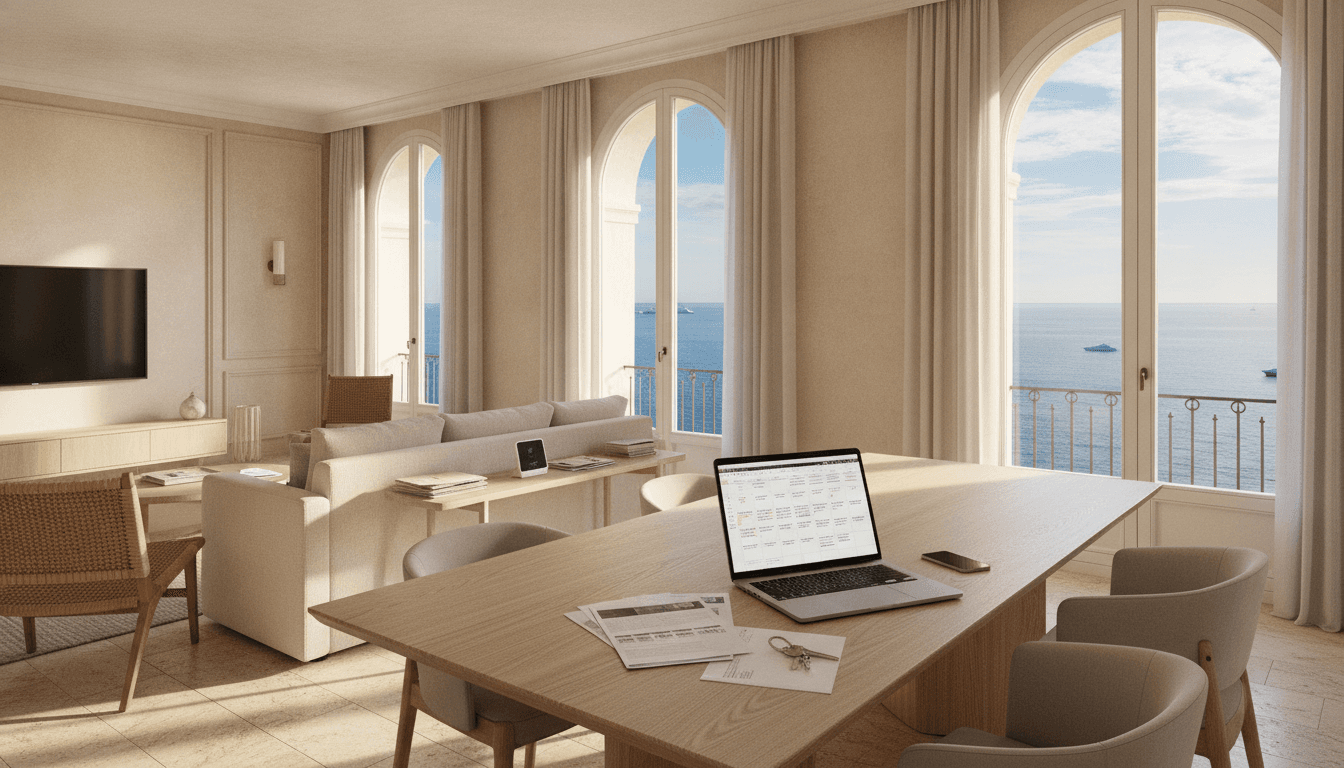
In France, the moment someone starts managing rents, charges or deposits on behalf of an owner, the legal framework changes. A mandat de gestion falls under the Loi Hoguet, and the professional handling those funds must hold a carte professionnelle G issued by the CCI. If you live in Paris, Geneva or London and your apartment in Nice or villa in Èze is left to “whoever is around”, that distinction matters quickly.
Remote property management on the French Riviera is rarely about one dramatic problem. It is about a chain of small obligations: humidity after a storm, mail from the syndic, a water meter that suddenly moves too fast, an insurance clause on vacancy, a contractor who needs access, a general meeting scheduled when you are abroad. Miss enough of them and the asset starts costing more attention than it should.
This is the working map we use for absent owners on the Riviera: what has to be organised, what you can do yourself, and where the boundary sits between Property Care and conciergerie.
What remote property management actually includes
Owners often use one phrase for everything: property management. In practice, two different jobs sit underneath it.
Property Care is the owner’s side of the property: condition, costs, tenants, paperwork, works, long-term value. That includes inspection planning, reading what the copropriété is asking for, comparing repair quotes, tracking ongoing maintenance, and deciding when a rental strategy or furnishing choice is costing more than it returns.
Conciergerie is the running of the address itself: opening for a plumber, welcoming a guest at a late hour, key handover, linen, groceries, checking the flat after departure, preparing before arrival, receiving parcels and practical call-outs.
If your question is “who attends to the asset in my interest while I’m away?”, that is Property Care. If your question is “who lets people in, prepares the home and handles the day’s logistics?”, that is conciergerie. The two meet constantly, but they are not the same service.
Maison Cinq Étoiles handles both sides, with the division kept clear: Property Care for the owner’s interest in the asset, conciergerie for the day-to-day operation of the address.
Monthly and seasonal checks for a second home on the Côte d’Azur
Most remote owners do not need a complicated system. They need a rhythm.
On the coast, that rhythm is shaped by salt air, humidity and periods of vacancy. An apartment in Beausoleil or Menton that stays closed too long can develop stale air, rising humidity, mould risk and small water issues that would have been simple if seen early. In a villa in Cap-d’Ail or Villefranche-sur-Mer, weather exposure, shutters, terraces and exterior equipment add another layer.
A practical remote-management routine usually includes:
- inspection visits on a fixed schedule, with photos and notes
- checking signs of humidity, condensation, mould and salt-air wear
- meter readings and alerts if consumption looks abnormal
- running taps, flushing, and checking for leaks or odours where relevant
- opening, airing and testing ventilation or dehumidification systems
- checking shutters, alarms, entry points and remote-access systems
- collecting mail and flagging anything from the insurer, the syndic or utility providers
You can do some of this remotely if the home is equipped for it. Smart security systems, remote access to gates, shutters, lighting and heating, and humidity monitoring all help. They do not replace a person on site. A sensor may tell you the level is wrong; it does not open the cupboard under the sink to see the beginning of a leak.
Maison Cinq Étoiles’s conciergerie covers these practical site visits and reports. Where an owner wants the broader asset view, our Property Care service adds the follow-up: what needs doing, what can wait, and which contractor should be compared before anyone is instructed.
Insurance, vacancy clauses and humidity: the checks owners forget
This is where absent owners get caught out.
French home-insurance policies often contain a vacancy or unoccupancy clause. Depending on the insurer, cover can be limited if the property is left empty beyond the period stated in the contract, especially for theft or water damage. If you leave a residence empty for long stretches, do not assume a standard policy still works as you imagine. Read the clause, and tell the insurer about prolonged absence where the contract requires it.
Humidity is the second blind spot. On the Riviera, sea air and closed interiors are a poor combination. The useful tools are known: VMC ventilation, standalone or whole-house dehumidifiers, some heat pumps with dry mode, and remote monitoring where the property is equipped for it. What matters is less the gadget than the routine. Someone must notice if the humidity level is drifting, if a machine has stopped, or if a bathroom with no airflow is starting to mark.
Formal insurance declarations are for the owner or the licensed property manager handling the file. Conciergerie can document the issue quickly, secure access, gather photographs and be present for the contractor or expert. Property Care is the part that keeps the paper trail in order and makes sure the matter does not stall.
Copropriété mail, general meetings and repairs: who does what when you are away?
If your property is in a French copropriété, the syndic is not optional once the building has at least two lots with different owners. The syndic handles common-area maintenance, finances, compliance and general meetings. As an absent owner, your risk is simple: decisions are made without your input because the email was missed, the post sat unopened, or no proxy was arranged.
So remote management needs a process for:
- receiving and reviewing correspondence from the syndic
- flagging agenda items that affect cost, works or rental use
- arranging representation by proxy, correspondence or videoconference where available
- tracking calls for funds, charges and building works
- checking how common-area decisions affect the private apartment
In Monaco, the regulatory setting is different, but the need for supervision is not lighter. Co-owners must hold civil-liability insurance, and the syndicat des copropriétaires must also be insured. For rental management in Monaco, the framework is closely watched, and proposed legal reform deposited in late 2025 aims to strengthen transparency and professional standards, including at least annual account reporting in rental management. For official information, see Monaco Pratique.
Maison Cinq Étoiles can receive, sort and escalate the practical side of this flow through conciergerie, and through Property Care we help owners understand what a repair, vote or building decision means for the asset itself. If a formal legal representation or handling of funds is required in France, that sits under the regulated framework and must be done by a holder of the carte G or in partnership with one.
Can a concierge manage rents and tenants? Not legally in every case
This is the point owners should get clear before signing anything.
In France, collecting rents, charges or deposits on behalf of a third-party owner, and operating under a mandat de gestion, requires the professional card G for gestion immobilière, issued by the CCI. The legal basis is the Loi Hoguet. Without that framework, a concierge service should not present itself as the legal holder of rental funds or the formal manager under a management mandate. For the official French framework, the relevant issuing body is the CCI.
That does not make conciergerie less useful. It simply defines its perimeter. Conciergerie can welcome guests, coordinate cleaning, hold keys, organise linen, report issues, prepare the property between stays and be the practical local contact. Property Care can advise on rental strategy, inventories, condition, oversight of tenants and contractors, and the owner’s decisions around maintenance and costs. But where the law requires a licensed real-estate professional, the licensed part has to sit in the right hands.
Maison Cinq Étoiles is direct about that line. If a task requires the regulated administrateur de biens framework, we say so plainly and work within that structure or alongside the licensed party. If it is an operational or advisory task on the ground, it is within our scope.
Works, furnishing and access: where Property Care meets interior design and cleaning
Distance makes small works harder than large ones. A major renovation usually has a clear team and schedule. A bathroom leak, damaged shutter, stained sofa after a tenancy, or tired rental furnishing tends to drift because no one is there to compare quotes, open the door, photograph progress and check the finish.
This is where owners often need more than one pillar.
Interior Design matters when the issue is not simply repair, but specification. In a short-let apartment in Nice, a fabric headboard, an open-pile rug or delicate bedside lamps may look right in photos and still be wrong for weekly turnover. In a private apartment in Monaco used part of the year, the better choice may be a material that tolerates closure, sea air and easier upkeep. Good furnishing decisions reduce future call-outs.
Cleaning also has a place here, though not as the whole story. Post-works cleaning, regular maintenance, end-of-lease resets, marble and material care, and turnover preparation all feed the condition of the property. A travertine floor, Carrara vanity or lacquered joinery should not be handed from one contractor to another without someone checking how it will actually be cleaned and maintained afterwards. Maison Cinq Étoiles is best known for cleaning, and this is exactly where that practical knowledge helps the owner’s wider decisions.
Our role across these pillars is concrete: supervise access, compare practical options, coordinate trades, prepare the site, finish the property for use, and specify materials and furniture that can be maintained in real life.
Remote property management checklist for absent owners
- Check your insurance wording for vacancy or unoccupancy clauses.
- Set an inspection rhythm for the property, with photo reports.
- Decide who monitors humidity, ventilation and visible water risk.
- Make sure mail from the insurer, utilities and syndic is received and reviewed.
- Plan how you will attend or be represented at general meetings.
- List all systems that need periodic checks: alarms, shutters, HVAC, dehumidifiers, gates.
- Clarify who can instruct contractors, who only reports, and who can hold funds legally.
- If renting, separate operational conciergerie from regulated rental management tasks.
- Keep an updated inventory of keys, access codes and remote controls.
- Review whether the furnishing still suits vacancy, tenant use and maintenance reality.
FAQ
What are the legal requirements for managing a rental property in France as a non-resident owner?
If someone is handling rents, charges, deposits or a formal mandat de gestion on your behalf, that activity falls under the regulated framework of the Loi Hoguet and requires a carte professionnelle G issued by the CCI. Practical local support such as check-ins, key holding and inspections is different and does not by itself amount to licensed rental management.
Does my home insurance cover my apartment if it is left empty for several months?
Often only within the limits of the contract. Many French policies include a vacancy or unoccupancy clause that can restrict cover after a stated period, especially for theft or water damage. The policy needs to be checked case by case.
How can I participate in copropriété general meetings if I do not live there?
Absent owners should organise representation rather than let the meeting pass without them. Depending on the situation, that can mean proxy, correspondence or videoconference. The important thing is that notices are received in time and the agenda is reviewed before the meeting.
Are there specific regulations for short-term rentals in Nice or Monaco?
Yes. On much of the French Riviera, towns including Nice, Menton and Roquebrune-Cap-Martin require registration for short-term rentals, and second-home owners may need change-of-use authorisation. In Monaco, short-term rental activity sits in a legal grey area and is uncommon in practice.
For absent owners, the hardest part is rarely one emergency. It is building a calm system before the emergency arrives. Maison Cinq Étoiles does that local ground work across Property Care, conciergerie, interior design and cleaning, with the legal boundaries kept clear.

Get in Touch
Interested in our services? Send us a message and we'll get back to you shortly.